Nine systems, cast properly
Each system is a complete charting module in its own right. Cast to the received rules, with every element on the chart openable to see what it rests on, and saveable as a record you can return to.
- Mingyi Four PillarsSee the pattern of destiny
- Zhongdao Qimen DunjiaForecast fortune & action
- Purple Star AstrologyDestiny by the stars
- Six Lines NajiaCast coins, read omens
- Sanyuan Da Liu RenFortune & its timing
- Plum Blossom NumerologyDivine by signs
- Xuan Jin Kou JueOne cast, many verdicts
- Yarrow Stalk DivinationGreat Expansion, eighteen changes
- Xuanzhen Feng shuiAuspicious layout analysis
Tap whatever you don't follow
On every chart page in Libo, almost every symbol you can see is tappable — the ten gods, hidden stems, nayin, life stages, void branches and shensha of a Four Pillars chart; the six relatives and the moving lines of a Six Lines cast; the nine stars, eight gates and eight spirits of Qimen Dunjia; the fourteen majors and the minor stars of Purple Star Astrology. Tap one and you get its reading.
Each reading comes in two layers. On top is the classical source, cited with its provenance — what San Ming Tong Hui or Yuan Hai Zi Ping actually says, quoted without edit. Below it is a plain-language interpretation of what that symbol means in this particular chart. The source accounts for where it came from; the plain reading accounts for what it does here.
So you needn't learn the vocabulary before you can read your own chart. Tap what you don't follow, read it, go back to the board — a dictionary of the art, laid flat across the chart.
Ask Master Libo, right where you are
The chart and the conversation share one screen — chart above, chat below — so you never leave one to reach the other. The chart stays in view while the question gets asked.
Any symbol on the board can be added to the conversation in one tap. What the Master Libo assistant then receives is not a bare term but that symbol’s position and relations within your chart — so "what does Peach Blossom mean in my chart" is answered about your chart, not out of a glossary.
The rest is just opening the box and saying it — the working and the reading come back line by line, right below the chart.
Try any of the nine charting systems
Start casting-
Mingyi Four Pillars八字 · Four Pillars
Four Pillars turns the year, month, day and hour of birth into four pillars of stems and branches, and reads the configuration a person is born with: where the five phases run thin or thick, how the ten gods stand, which way the luck pillars run. Temperament and disposition, the shape of wealth and standing, the rise and fall of the road ahead are all drawn out of these eight characters.
When the subject is the pattern of a whole life, Master Libo works from Four Pillars as the ground chart. The four pillars are the draft a person carries for a lifetime: how hard or soft the temperament runs, how thick or thin the family ties, how fortune advances and retreats — all of it is derived from here, and the broad direction of a life first shows itself here.
The casting is done by deterministic algorithms: true solar time, solar-term boundaries and leap months all follow the received rules rather than an approximation, so the same birth data always yields the same chart. With the chart in hand Master Libo works through the Four Pillars knowledge base and the Four Pillars library of classics, so a conclusion can be traced to the passage it rests on.
-
Zhongdao Qimen Dunjia奇門遁甲 · Qimen Dunjia
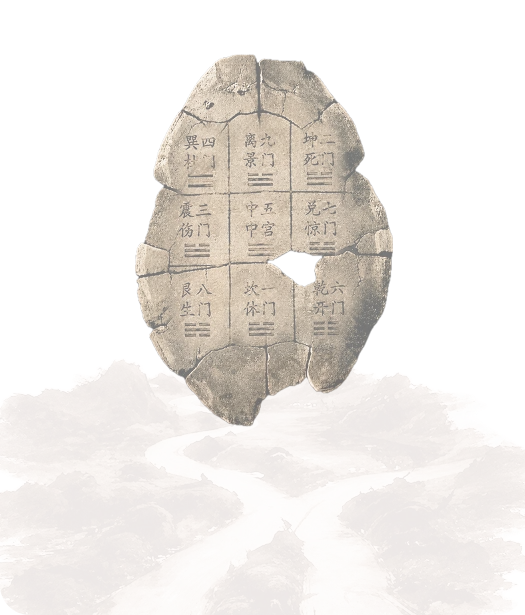
Qimen Dunjia lays out nine palaces for the moment a chart is cast, and seats the eight gates, nine stars, eight spirits and the heaven and earth stems among them. It does not ask who you are. It asks what configuration of time and space this matter sits in — where the gate is open, where the road leads, who is standing in the way.
When something is hanging unresolved, Master Libo casts Qimen Dunjia. What it judges is the step immediately in front of you: which palace it falls in, whether to move or hold, which direction runs clear. Commanders once used it to move armies, and for exactly that — the discernment of direction and timing.
The pattern number, the duty-symbol and duty-envoy, the void branches and the horse star are all fixed by the received casting rules, not left to the model. The reading returns to the Qimen Dunjia knowledge base and the Qimen Dunjia library, where palace, gate, star and spirit each have their textual basis.
-
Purple Star Astrology紫微斗數 · Purple Star Astrology
Purple Star Astrology lays a life out across twelve palaces and places the stars among them. Self, wealth, career, travel, marriage, children — the circumstances of a life are divided into twelve places, and a star governs the affairs of whichever palace it falls in. Which palace is crowded and which is bare is visible at a glance.
As soon as a question has a subject and a setting — this relationship, this relative, this job — Master Libo reaches for Purple Star Astrology. That is where the palace system is strong: which palace wealth comes through and which star governs it, which star sits in the marriage palace. Everything has its place, and the reason can be stated.
The twelve palaces, the four transformations and the decade and annual cycles are all computed to the received rules. The reading is worked against the Purple Star Astrology knowledge base and the Purple Star Astrology library, so star natures, palace meanings and chart formations each have a source.
-
Six Lines Najia六爻納甲 · Six Lines
Six Lines casts a hexagram, then fits each of the six lines with stems, branches and a kinship role — parent, sibling, offspring, wealth, officer. Whatever is being asked determines which line is the subject, and the reading follows that line: is it strong, does anything support it, and where does it change to if it moves.
Will it come off, will it be got, can it be secured? For those Master Libo casts Six Lines. Its strength is that it narrows a matter down to one identified line — not a general verdict on how things look, but a statement of where the crux sits and how that line stands right now.
Fitting the lines, assigning the stems and branches, and locating the subject, object and void branches all follow the received rules. The reading returns to the Six Lines knowledge base and library, where the standard texts sit passage by passage with a plain-language rendering beside them.
-
Sanyuan Da Liu Ren大六壬 · Da Liu Ren
Da Liu Ren first raises the heaven and earth boards with their twelve generals, then derives three transmissions from four lessons. The three transmissions are its signature: initial, middle and final lay a matter out as a line — where it came from, where it stands now, where it is going — settled within a single casting.
How will this go, and when will it resolve? For that kind of question Master Libo usually turns to Da Liu Ren. The twelve generals govern the traffic of human affairs; the three transmissions fix the term within which a matter comes due. How people are bound up with one another, and when a thing will settle, is what this system is strong at.
The four lessons, three transmissions and the shensha follow the received casting rules, matched against the same reference table the charting service uses. The reading is worked against the Da Liu Ren knowledge base and library.
-
Plum Blossom Numerology梅花易數 · Plum Blossom Numerology
Plum Blossom Numerology takes the shortest road to a hexagram: a moment in time, or a number someone says aloud, is enough to cast. Out of it come the primary, nuclear and changed hexagrams, divided into substance and function. What it reads is the image — the shape a matter has taken on right now, and the shape it is turning into.
When a question arrives in a hurry and is still vaguely put, Master Libo casts Plum Blossom Numerology first. An image can be taken the moment something prompts it, without waiting for the matter to be told in full: the hour of the encounter, the number spoken, the sound overheard will each make a hexagram and give a direction to begin with.
Casting, the nuclear and changed hexagrams, and the substance-function relations all follow the received rules. The reading is worked against the Plum Blossom Numerology knowledge base and library, where the source text itself is held.
-
Xuan Jin Kou Jue金口訣 · Jin Kou Jue
Jin Kou Jue casts on four positions only: the ground division, the leading spirit, the noble spirit and the human stem. Once those four are up, the five-phase relations and the strength of each kinship role can be read straight off. One casting, many verdicts, an answer on the spot: the speed of the casting and the directness of the judgement are the character of this system.
When a question arrives urgently and needs a judgement usable right now, Master Libo casts Jin Kou Jue. “This step, at this moment: favourable or not, move or hold?” — that sentence is exactly what comes back, quickly and concretely.
The stems and branches of the four positions, their strength, the void branches and the shensha are all fixed by the received casting rules. The reading is worked against the Jin Kou Jue knowledge base and library.
-
Yarrow Stalk Divination大衍筮法 · Yarrow Stalk Divination
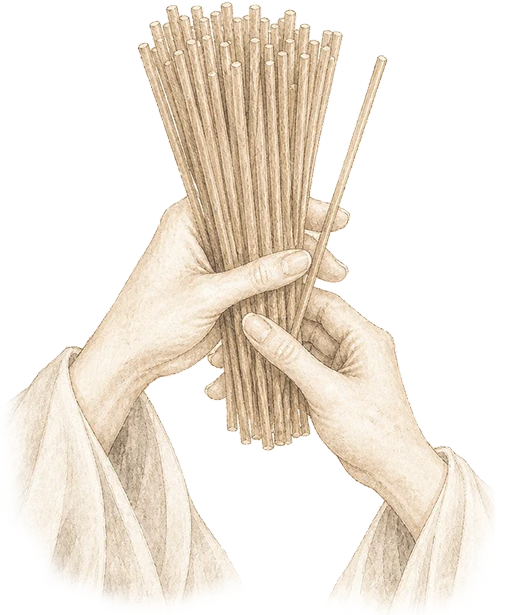
Yarrow Stalk Divination is the casting method the Book of Changes carries in its own text: fifty yarrow stalks of which forty-nine are used, four operations to a change, eighteen changes to a hexagram. What comes out is not only a hexagram but the old or young yin and yang of every line — which line moves, and what it moves into, is decided across those eighteen changes.
When an answer needs to come back to the text itself, Master Libo uses Yarrow Stalk Divination. The judgement is taken straight from the hexagram and line statements of the Book of Changes together with the Tuan and Xiang commentaries. On questions of what to take up and what to let go, of advancing or withdrawing, of how to conduct oneself, the text carries its own weight.
All eighteen changes follow the Great Expansion number set out in the Xici commentary, and each one can be reviewed. The reading rests on the Book of Changes itself alongside the Yarrow Stalk Divination knowledge base, with hexagram statements, line statements and commentary read together.
-
Xuanzhen Feng shui玄空飛星 · Flying Star Feng shui
Feng shui does not read the person. It reads the place the person is in. Flying Star arranges the period and the sitting-and-facing into nine palaces, seating the mountain star, the water star and the period star in each, so which quarter favours people, which favours money and which carries harm is laid out on one board.
For a house, a shop or an office, Master Libo casts Feng shui. The same person can live very differently in two different houses, and the difference lies in the sitting and facing, the layout, and how these meet the annual stars. Where to open the door, where to put the bed, where to set the desk — what suits and what to avoid becomes clear only once it is brought down to this board.
Periods, sitting and facing, and the flight paths follow the Jiang-school Xuankong tradition; Master Libo is a twenty-fourth-generation lineage holder of it. The reading is worked against the Feng shui knowledge base and library, where the standard geomantic texts are held.